Black Holes All the Way Down
Exploring black hole cosmology and the possibility that the Big Bang was the formation of a black hole, seen from within.
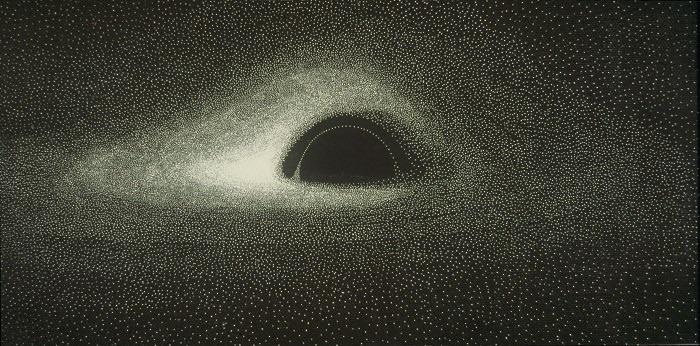
Black holes have always been physics’ ultimate reflecting pool. We usually describe black holes as endings: collapsed stars, lost information, matter falling past the point of no return. But black holes may not be endings at all. They may be the engines by which universes reproduce.
One of the most intriguing ideas in gravitational physics is black hole cosmology: the proposal that our universe may itself exist inside the interior geometry of a black hole in a larger parent universe. The idea dates back to Raj Pathria in his 1972 paper "The Universe as a Black Hole" and has lingered at the edge of cosmology ever since, elegant, unsettling, and difficult to test.
It changes nothing about our daily lives. The coffee still cools. Planes still fly. Markets still open. Yet it rearranges the meaning of the fabric of reality.
The Big Bang, in this view, was not the spontaneous appearance of our universe from nothingness. It was what gravitational collapse looks like from the other side of an event horizon.
General relativity already tells us that black holes are not merely dense objects sitting in space. They are transformations of spacetime itself. At the event horizon of a simple black hole, the roles of space and time begin to flip: the Schwarzschild time coordinate becomes spacelike, while transiting deeper into the black hole becomes timelike. Inside the horizon, moving toward the singularity is no longer motion through space: it is motion toward the future. Just as we cannot avoid tomorrow, matter inside a black hole cannot avoid falling deeper into the geometry.
Seen from two sides, gravitational collapse and the birth of a universe start to look like the same event. From outside, in the parent universe, matter falls inward and vanishes past the point of no return. From inside, it's the reverse: space is not standing still but stretching and growing. And if the center is not truly an end (and if some deeper physics smooths the singularity instead of letting it crush everything to a point) then the fall never ends. It opens outward. What looks like collapse from the outside becomes, from the inside, a universe being born.
The possibility that black holes contain universes within their event horizons is worth taking seriously because it connects several observations about our universe into one coherent picture:
In a statistically isotropic universe, with no preferred cosmic direction, we would expect spiral galaxies to rotate clockwise and counterclockwise in roughly equal numbers, at least at large enough scales. But analyses of deep-field observations from James Webb have reported asymmetry: more galaxies appearing to rotate one way than the other. If the effect survives further scrutiny, it may suggest that the universe has a large-scale axis: a faint memory of rotation built into its initial conditions.
Of course, the asymmetry may turn out to be an artifact of measurement: selection bias, Doppler effects, or something subtle about how galaxy brightness is observed from our position inside the Milky Way.
But if the James Webb observations hold up, it would be extraordinary. Standard cosmology assumes the universe is the same in every direction at the largest scales. A global handedness like what was observed last year from James Webb would not fit that assumption.
Where the observation would fit, though, is if our universe were born inside a rotating black hole. Most real black holes spin. The exact interior of a rotating black hole is far more complicated than the simple Schwarzschild case, and no one should pretend an axis inheritance mechanism is settled. But if a child universe could inherit even a faint imprint of its parent’s angular momentum, it might be born with a preferred axis. The handedness of galaxies would not be random noise. It would be a fossil record.
Black holes also grow as they ingest matter. In a child-universe model, that growth might alter the boundary conditions or the total mass-energy available to the interior geometry. Matter falling in would not pass through intact, like cargo through a tunnel; of course ordinary structure would be destroyed. But the mass-energy could still become part of the foundation from which a new universe evolves and produces its own matter, stars, planets, and life.
Even the density of our own universe carries an unexpected echo of this theory. Black holes do not have to be distinctly dense at large scales. A black hole with a radius of about 100 astronomical units (roughly the outer scale of our solar system) would actually have an average density lower than air.
Push that to the largest scale, about 14 billion light-years out (the Hubble radius, where the expansion of the universe carries galaxies away from us at the speed of light), gather up all the mass and energy inside the sphere, and it is roughly the amount mass density it would take to make the sphere itself a black hole. The universe at its Hubble radius is about as dense as a black hole its own size.
Of course that does not prove the universe is a black hole. A universe is not simply a ball of matter sitting inside a larger empty space, and the expanding geometry of our universe is not the same as the local geometry around a simple black hole. But, the fact is curious. It hints that black-hole physics and our universe's cosmology may be more closely linked than they first appear.
Thus, the Big Bang may not have been an explosion. It may have been the other side of a gravitational collapse.
That makes black holes conceptually closer to seeds than graves. A star collapses in one universe; a horizon forms, and beyond it, the collapse may be reinterpreted as the birth condition of another distinct spacetime, its own Big Bang. What looked like an ending from outside becomes the emergence of new geometry within.
If this is true, every black hole in our universe may contain its own child universe too.
What General Relativity Actually Proves
There is a disciplined version of this idea, and it begins with classical general relativity (GR).
The full conjecture:
- A parent universe forms a black hole.
- The black-hole interior is locally a Kantowski–Sachs cosmology.
- Classical GR drives that cosmology to a spacelike singularity.
- A new high-curvature law resolves the singularity.
- The resolved region evolves into an expanding, causally separated universe.
The event horizon of a Schwarzschild black hole is not where spacetime ends. In ordinary Schwarzschild coordinates the metric appears to break down at r = 2M, but this is a coordinate failure, not a physical singularity. With better coordinates, the geometry extends smoothly through the horizon. The real classical singularity is at r = 0.
What changes at the horizon is the causal role of the coordinates. Outside the black hole, the Schwarzschild time coordinate is timelike and the radial coordinate is spacelike. Inside the horizon, their roles reverse: more precisely, decreasing areal radius becomes timelike. It is no longer merely movement through space; it is movement toward a future.
If we rename the interior radial coordinate as a time coordinate, the Schwarzschild interior can be written as a Kantowski–Sachs cosmology (a universe with a built-in axis): homogeneous, anisotropic, and time-dependent. It is not an ordinary Friedmann–Robertson–Walker universe (smooth, same-in-each-direction kind of universe) like the one used in standard cosmology, but it is a cosmological spacetime in a precise mathematical sense. That is what classical general relativity gives us.
This does not, by itself, prove that black holes contain successful child universes. The classical Schwarzschild interior still ends at a spacelike singularity in finite proper time. To turn that interior into a long-lived expanding universe, you need additional physics: a bounce, quantum gravity, torsion, a de Sitter core, or some other mechanism that resolves the singularity into a new expanding branch of independent spacetime. Nikodem Popławski has developed one of the most explicit versions of this idea through Einstein–Cartan gravity: in that model, the intrinsic spin of matter generates torsion, producing an effective repulsion that can halt collapse at finite density and rebound it into a new, expanding universe behind the horizon.
So the careful claim is not that black holes are proven to create universes. The careful claim is that general relativity already makes black-hole interiors look cosmological. If the singularity is resolved rather than final, black holes become natural candidates for the birthplaces of causally disconnected universes.
Cosmological Natural Selection
This idea has a name and an author. The physicist Lee Smolin proposed it in 1992, and developed it in The Life of the Cosmos, as a deliberate alternative to the Anthropic principle: he called it cosmological natural selection.
Anthropic, the AI firm, draws its name directly from the Anthropic principle, a philosophical concept in physics suggesting that the universe's physical laws are fine-tuned to make the existence of conscious, intelligent life possible.
Universes whose physical laws allow stars to form will also form black holes. Universes that form more black holes would, in this framework, produce more child universes. Over enough generations, reality would become biased toward universes capable of making stars, galaxies, and black holes.
Reproduction here would not mean duplication. It would mean descent with variation: new universes inheriting only traces, parameters, or boundary conditions from the collapse that formed them.
Wilder still, life may not be the point of the process, as the Anthropic principle poses. Black holes may be. We may be even smaller parts of a universal engine than we could ever imagine.
We tend to ask why the universe is so hospitable to observers like us. But perhaps that is the wrong question. A universe hospitable to black holes will also tend toward complexity: stars, heavy elements, long-lived structure are all required for both. We may not be the target of cosmic selection so much as a side effect of a universe optimized for reproduction through gravity itself.
If so, the universe is not a one-time miracle. It is part of a gravitational lineage.
Parent universes form black holes. Black holes form child universes. Child universes grow, cool, form stars, fuse heavier elements, and eventually produce black holes of their own. Reality becomes a branching tree of causally sealed interiors behind an infinite set of event horizons, each universe unable to see its parent, but carrying traces of the event that made it.
We look at black holes and see the limit of knowledge. Perhaps we are really looking at the foundation of reality, all the way down.